Saturday, April 20, 2013

BEST Album of 2012 - Brad Stock's Atomic Clock - Timeless and Timely

It isn't uncommon for someone to give me a copy of their personal music CD to review. It is, however, uncommon when the gift engages my interest. And then, there's the one in a million that turns out to be something special. 


Brad Stock's Atomic Clock is Something Special.

Last year, I drove to Salt Lake to watch Pink Floyd's The Wall at Brewvies Cinema Pub where Salt Lake's local, listener-sponsored community radio station, KRCL, hosts a monthly Night at the Movies to help fund broadcast operations costs. I hadn't seen The Wall in a theater since it was first released in 1982, and I was looking forward to watching it on the big screen again. 

As I sat in the dining area awaiting the theater doors to open, I spied an unassuming gentleman sitting at the bar wearing a Pink Godzilla T-shirt, a rare and unusual sighting behind the Zion Curtain.

Pink Godzilla is a sushi restaurant on 41st Avenue in Santa Cruz that the locals all call Pinky G's. "Maybe he's from my little beach town," I mused as I approached him and asked:


"Did you get that Pink Godzilla T-shirt in Santa Cruz?" 

"Yeah, did you get that DJ's Mini-Mart T-shirt in Santa Cruz?" was his reply.

I had forgotten that I was wearing my DJ's T. As you might have guessed, the gentleman wearing the Pinky G's shirt turned out to be Brad Stock. He was there to see The Wall too, and apparently had thematically selected his shirt for the occasion. I'm happy that he did, otherwise, I may have never met Brad Stock or heard his amazing Atomic Clock, Rhetro Zenberg's selection for BEST Album of 2012.

As Brad Stock and I chatted before the movie began, I learned that he was an avid surfer and had picked up the Pinky G's shirt whilst on a surfing trip to Santa Cruz. He also told me about his newly completed CD that he was obviously very excited about, and presented me with a fresh copy of the Atomic Clock CD along with some Blorbs - decal replicas of the disc image that I'm seeing stuck on signs nearly everywhere I go these days.


Brad made me promise that I'd wear headphones the first time I listened to his album. He wanted to ensure that I'd have the opportunity to appreciate the quality and depth of the music. I was tempted to play it in the car on my 40-minute drive home, but I refrained, and waited until I could listen as Brad had prescribed. 

Time to Hear the Atomic Clock

I prefer to listen to new music on headphones for my first listen anyway, so I was comfortable with the notion of taking time late at night, to sit alone in the dark. With no visual distractions and the phones snug against my ears, I pushed play, laid back, closed my eyes and heard "the Sun" rise. Before I knew it, "the Moon" was coming up like a big bald head and I had completed my first experience with the Atomic Clock. The music had drawn me in so deeply that I felt as though I had been meditating. 

The first time hearing the Atomic Clock was moving in a way that was natural and cosmic... kind of like the first time that I heard Pink FloydNot to say that the Atomic Clock is anything like Pink Floyd or progressive rock in general for that matter. The Atomic Clock doesn't overwhelm the listener with the excessive experimentation that occasionally* drags down progressive rock compositions. The Atomic Clock resonates with a vibe of goodness, whereas prog rock tends** to be a bit gloomy. There's no time for doom n gloom on the Atomic Clock - which is more of a soundtrack for living and celebrating life. It's all good.

Clockwerks

The Atomic Clock consists of ten unique and nicely woven compositions that eclectically bridge any genre gap. The songs are all cleverly written, and obviously composed by someone who possesses a wide scope of life experience and musical influence.***  The songs demonstrate a broad variety of flexibility and depth that keep the listener intrigued and engaged. No two are alike, nevertheless, each has its time in the spotlight. To me, one quality that stands out on the Atomic Clock, is its timelessness. It doesn't seem to be restricted to time and space or style.

For the most part, the Atomic Clock is feel-good music that makes a nice soundtrack for anything you might be doing. Brad told me that he wanted to make music "that would move and reach people." It turns out that the Atomic Clock is the result of a late night wish in Hawaii. Brad recalled that night, "while standing outside, looking up at the night sky, I put my wish out there." 

When the choice came down to a significant five minute decision at the bus station, Brad remembered the words of a wise friend who had encouraged him to follow his bliss. Brad's journey had led him to a place where he'd have to decide - which bus to take. Brad remembered his trusted friend's advice and heeded his counsel. On the bus ride of life, Brad Stock's alternative destination would have materialized drastically different had he taken the other bus. 

Brad followed his bliss all the way to the Beehive State where he met music producer Matt Winegar**** who had availability in his schedule at the perfect time to produce the Atomic Clock

Matt Winegar told me in an interview that he really enjoyed working with Brad on the project and is happy with the way it turned out. He told me that the song, "It Blows" is one of his favorite tracks on the album, and one of the most memorable. Brad remembers that when they began working on that song, Winegar asked him:


"How Zappa do you want to go on this one?" 

Brad remembered that Zappa percussionist, Ed Mann, was a Facebook friend, and decided to invite him to play on the track. "I sent him the song and he said he dug it and would be happy to play on it..." Winegar remembers that Mann provided a lot of great sound surprises, including a nifty little marimba riff that adds to the already prevalent Zappa nuance. 

The Atomic Clock is awesome and timely on many levels and Matt Winegar's production skills augmented Brad's talent and personal vision of the songs. The track, "Hoot 'n Holler Annie" features some lovely strings***** and a beautiful arrangement for an intriguing song about a toe found on the side of the road. It makes me ponder what a Nilsson/Martin team might have realized had they worked together. "Hoot 'n Holler Annie" is about as close as you'll get. 

The song, "One of My Better Days," is an upbeat semi-Reggae song about a day that is good because of all of the things that didn't happen, such as: 


"I Didn't lose my music to a glitch in my iTunes...
...Didn't get crushed by a random boulder..."   

I don't have a favorite song on the Atomic Clock, but I regularly find myself singing or whistling the ultra catchy tune "Chasing the Buddha...til we meet again."


In conclusion, like I always say, "If life is fair" the Atomic Clock will become a classic. It already is on the Zenberg Blogue and for a handful of lucky people who have already discovered it. Congratulations to Brad Stock, and everyone who contributed to making the Atomic Clock a reality. Tis a fine contribution to the musical universe. God speed to ya Brad Stock!


3D image of Brad Stock standing on Mars at the Clark Planetarium where the Atomic Clock was featured for two runs as a CSI laser show in the main dome. The light show is rumored to be appearing in other major cities in the near future. Don't miss it. 

NOTES 

* Certainly not always.

** Generally but not as a rule. The positive aspect of the Atomic Clock is what ultimately earned it Best Album status. Other albums under consideration this year, (Anywhere by Anywhere and Spine Hits by Sleepy Sun), were a bit dark. 

*** Adrian Belew, Al Stewart, the Beatles, Nilsson, Zappa to name a few

**** Matt Winegar has engineered, recorded and produced for such notables as Primus, Coheed in Cambria, Faith No More, to name a few. His recording studio is located in Salt Lake City.

***** This lovely string section was performed by Callie Reed who played both violin and cello on the track. 

purchase the Atomic Clock: http://www.bradstockmusic.com/

Wednesday, March 27, 2013

I've lost count of how many times I've shoveled snow this winter. My neighbor, Dylan, has been nice to clear the sidewalk in front of my house a couple of times with a snow blower. I have been using the old school method - snow shovel, which is sadly the only real exercise I get.

Three inches of ice covered by a foot of snow atop my roof for months on end has been far too common, therefore, earlier this month, a friend and I drove all the way to Santa Cruz, CA to get away from what seemed like an unrelenting winter, and to do some stuff that can't be enjoyed here in Utah, behind the Zion Curtain. 
One of the primary reasons we went to Santa Cruz was to see the Residents 40th Anniversary Tour at the Rio Theatre. Their final show on their US tour. 
The Residents power trio of Randy, Chuck and Bob played some of their biggest hits and even did a tribute to the late great Snakefinger. 
I love going to the Seabright Beach overlook at Atlantic Ave and 3rd where it is common to see a large peace sign constructed on the sand. 
I was getting some strange vibration sounds when driving between 15 and 20 mph, so I took my car to my mechanic friend, Waid, who checked it out thoroughly and informed me that it was only a tire wearing issue. Waid didn't even charge me for the inspection. I replaced and upgraded the tires when I got back to Utah. 

While we were waiting for Waid to inspect my car, we took a loaner over to Rosicrucian park in San Jose to check out the Egyptian museum there but unfortunately it was closed that day. 
The grounds of the museum and park were a nice place to relax whilst we waited to hear from Waid.


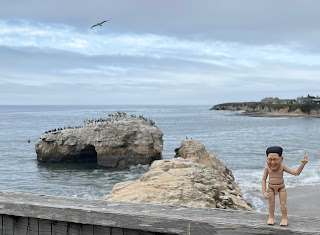
As usual, the pacific Ocean was spectacular. This picture was taken at Natural Bridges State Park.
Aaron's two grapefruit trees presented us with a most delicious specimen... BEST grapefruit I've ever eaten. 
And one that was a bit over-ripe.
The snails were having their way with Aaron's garden. He battled the slimy creatures every night and by the time we departed, it appeared that he had the upper hand on the situation. 
Before leaving town, we stumbled on a Blorb on Pacheco Avenue. God bless Brad Stock!
Twas wonderful to see my kids and SO many good friends. SO difficult to leave. I'll be back.

Saturday, February 16, 2013

Land Grab - First US Military Reserve in Utah Territory


In the mid nineteenth century, making a detailed survey of the western part of the United States was a major priority for the government. Waterways, routes, and resources needed to be mapped by competent surveyors to best facilitate the great expansion westward. It wasn't an easy job, and many of these early explorers lost their lives as a result of environmental and natural hazards like floods, falls and landslides, while others were killed by natural predators and in some instances by hostile natives.

In 1853, the wild wild west was yet to be tamed when experienced surveyor, Captain John Williams Gunnison was dispatched with an expedition to survey a route for a railroad between the 38th and 39th Parallels inside the mostly unexplored Utah Territory. The natives in the area were restless and viewed the white man as foreign invaders of their lands. In late October, 1853, the survey party was attacked by a band of Ute Indians, leaving Gunnison and seven of his men dead and mutilated. Gunnison's widow, and others, claimed that the massacre had been masterminded by Mormon Prophet, and Utah Territory Governor, Brigham Young. She asserted that a mob of Mormons had dressed up as Indians, painted their faces, and attacked the survey party.

Hyped up rumors of a Mormon rebellion were common, and the government feared the possibility of Mormons uniting with the natives to battle the United States Army. The Mormons, who 
had arrived in the territory less than a decade earlier, had a history of governmental misrepresentation. They had endured numerous bigoted persecutions in the Midwest, and were effectively driven out of the land of the free to face more hardships migrating thousands of people across the vast expanse of North America. They carved out a place in the Rocky Mountains where they had hopes of exercising their religion without fear of mob brutality, and governmental intervention.

The Mormons had been in the Salt Lake Valley for only six years, and were already being viewed with suspicion by outsiders, when news of Gunnison and his party's demise reached Washington. As a result of what has become known as the Gunnison Massacre, and other rumors and tales of woe concerning the activities of Mormons behind the Zion Curtain, in 1854, US President Franklin Pierce deployed battle-tried Colonel Edward Jenner Steptoe, along with 175 hardened troops consisting of two companies of artillery and one infantry division to the Utah Territory to investigate the massacre of Gunnison's party, assess the Mormon rebellion and hostile Indian situation. Col. Steptoe had also been instructed by President Pierce to replace Brigham Young as governor... by force if necessary.

A West Point Graduate, Colonel Steptoe had proven himself to be a dependable officer who knew how to deal with the enemy. On August 31, 1854, Steptoe and his troops arrived in the arid, hot and mostly undeveloped Salt Lake Valley. The colonel was aware that the Indians could not be defeated without cooperation from the Mormons, and when the situation had been assessed, he determined that the Latter-day Saints were reluctantly necessary allies of the US in subduing the Native Americans, and making the country safe for settlers and travelers. Colonel Steptoe therefore refused his gubernatorial appointment, and recommended to President Pierce that Brigham Young remain in office as Utah's governor.

On September 2, 1854, Steptoe relocated his battalion near the east shore of Lake Shambip, (later renamed Rush Lake), a few miles south of Tooele, where they constructed stables and barracks to house the hundreds of men and animals of the deployment force. Steptoe designated the area as a US Military Reserve, and erected survey monuments marking the extensive boundary. The following spring, the deployment force of over two-hundred men left for Benicia, California to resupply the arsenal there.

Eventually, the military had little to nothing to do with the Rush Lake Military Reserve, but the approximately 48,000 acres of land still belonged to the army, therefore, anyone who attempted to homestead within the boundary was denied property rights. It took many years for the squatters to obtain legal deeds to their properties, many of which had been described and located from the original survey markers that had been established by Steptoe in 1854.

Don Rosenberg first became aware of the Military Reserve when he was a practicing registered surveyor, and discovered the old deeds that had been described and based on the Military Reserve boundary monuments. He was later elected Tooele County Surveyor, and made it a priority to preserve the location of the old original monuments, and in 1991, successfully retraced Col. Steptoe's original survey and relocated most of the original monuments of the Military Reserve. At the base of each corner monument, we set a 2" steel pipe with an official Tooele County Surveyor brass cap marked, "USRB CORNER." Rosenberg recorded a tie sheet showing the location of each corner and the boundary line on the maps of the dependent re-survey that is on file at Tooele County.

Other than the survey markers that were relocated in the 1991 re-survey, today little evidence remains from the time of Steptoe's short-lived military occupation on the shore of Rush Lake. A lonely historical marker established by the Daughters of Utah Pioneers on August 20, 1941, stands alongside Highway 36, about 1.7 miles south of Stockton, Utah. The twelve foot tall monolith has a large bronze plaque with the following information inscribed:

"A detachment of the U.S. Army, the first to enter the Rocky Mountain region, consisting of two companies of artillery, 85 dragoons, 130 teamsters, herders, and hostlers from Ft. Leavenworth, Kansas, under the command of Col. E. J. Steptoe reached this point 2 Sep., 1854. They erected quarters, stables, and corrals, cut 200 cords of wood and stored 200 tons of hay for their 450 mules and 300 horses. The camp was located on the east shore of Lake Shambip (Rush Lake). The detachment left for Benicia, California in early April 1855."

The abandoned Military Reserve at Rush Lake represents the first time troops would be deployed in Utah, but it certainly wasn't the last time the military would occupy land in the region.

* Published References:
History of Clover 1856-1956 pg. 1,
History of Tooele County (1961) pg.287, 340
History of Tooele County Vol. 2, (1990) pg. 42-44
A History of Tooele County - Compiled by Ouida Nuhn Blanthorn for the Utah Centennial County History Series (1998) pg. 58-59, 289-291